
Your next best client may already have a preference about you, and you had nothing to do with forming it.
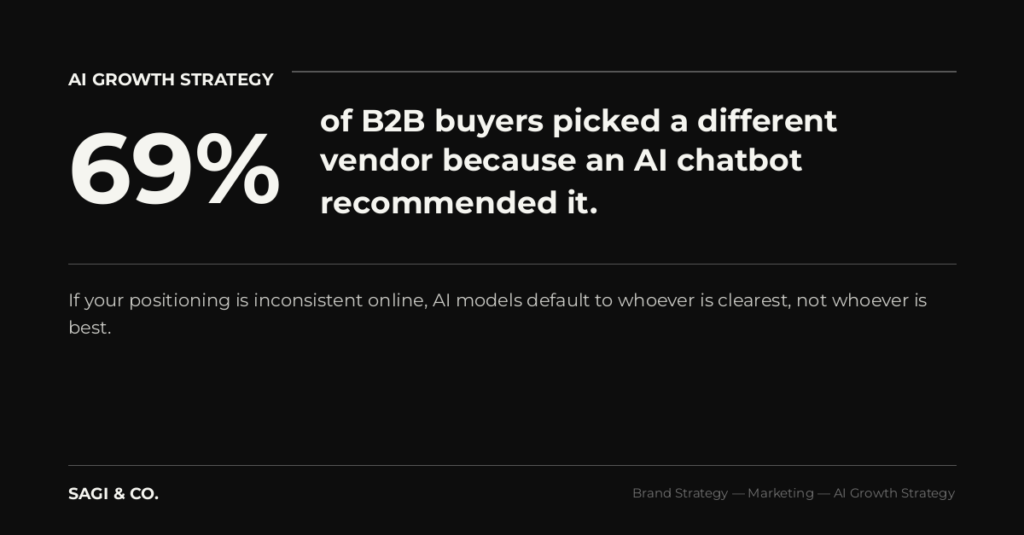
According to G2’s March 2026 buyer survey, 51% of B2B buyers now start their research in an AI chatbot more often than Google, up from just 29% a year earlier. More striking: 69% of B2B buyers say they chose a different vendor than they originally planned because of what an AI chatbot recommended, and 33% bought from a vendor they’d never even heard of before the AI surfaced it. Your buying committee isn’t just Googling you anymore. They’re asking ChatGPT and Perplexity to summarize you, compare you, and recommend someone. Brand visibility in AI search has quietly become the new front door to your pipeline, and most companies haven’t updated the locks.
This isn’t a technical SEO footnote. It’s a positioning problem, which means it’s a leadership problem before it’s a marketing one.
The New Gatekeeper Doesn’t Read Your Website the Way You Think
Search engines used to rank pages. AI models synthesize an answer. When a buyer asks an AI tool “who’s the best branding partner for a growth-stage company in Miami,” the model doesn’t hand back ten blue links for the buyer to sort through. It picks a short list and describes each option in a sentence or two, pulled from whatever it has absorbed about you across the web: your site, press coverage, review platforms, podcast transcripts, LinkedIn posts, client case studies, even forum threads.
If that composite picture is thin, outdated, or contradictory, the model either leaves you out or describes you in a way you wouldn’t recognize. You don’t get a chance to correct the record in real time. The AI has already spoken before the buyer ever lands on your homepage.
Why Fuzzy Positioning Gets You Left Out
Here’s the part that should concern any CEO who’s grown past their original brand: AI models resolve ambiguity by defaulting to whoever is clearest, not whoever is best. If your positioning statement changes depending on which page of your site you’re reading, or if your team describes what you do differently than your website does, the model has no confident sentence to draw from. It fills the gap with something generic, or it fills the gap with a competitor.
This is precisely where growth-stage companies get hurt. You’ve outgrown the brand you launched with, your offering has matured, but the language describing you online is still scattered across five years of inconsistent updates. A model summarizing you today is summarizing that mess.
The Citation Stack: A Practical Framework for AI Visibility
Rather than chasing every new AI visibility tool on the market, we’ve found it more useful to think about brand visibility in AI search as three layers, in priority order.
Owned: give the model something clean to quote. Your site, your about page, and your case studies need one unambiguous sentence that answers “what do you do and who is it for.” Structure your content so a model can lift a clear claim without having to infer one. This means direct, declarative language, not clever taglines that require context to land.
Earned: exist in the places models actually crawl. Reviews, press mentions, podcast appearances, industry roundups, and third-party comparisons carry more weight with AI models than your own marketing copy, because they read as independent confirmation. If you’re not present on the review platforms and publications your buyers already trust, you’re invisible to the systems summarizing your category, no matter how good your website is.
Consistent: repeat the same positioning everywhere, on purpose. The fastest way to improve your AI visibility isn’t a new campaign, it’s an audit. Pull your last twenty pieces of public-facing content, from your site to your LinkedIn to your press quotes, and check whether they describe you the same way. Most companies are shocked by how much drift has crept in.
How to Audit Where You Stand This Week
Before investing in anything, run a simple test. Ask ChatGPT and Perplexity directly: “who are the top [your category] firms for [your target client]?” See if you appear. Then ask “what does [your company name] do?” and compare the answer to how you’d describe yourself. The gap between those two answers is your actual brand visibility problem, stated in plain language, no dashboard required.
We’ve watched founders discover through this exercise that the AI’s summary of their company was two positioning iterations behind where the business actually is, built entirely from outdated case studies still ranking in search. The fix wasn’t a rebrand. It was cleaning up the record.
Where to Start This Quarter
Prioritize in this order: first, write and lock a single, unambiguous positioning sentence, and make sure it’s the one sentence used everywhere, from your homepage to your LinkedIn bio. Second, audit your presence on the third-party platforms your buyers actually check, and close the biggest gaps. Third, re-run the ChatGPT and Perplexity test every quarter, the way you’d check analytics, because these models update and your standing shifts.
This is also exactly the work we walk clients through at Sagi & Co when their brand has outgrown its own paperwork: get the positioning airtight first, then make sure it’s the version of you that’s actually being told, whether the audience is a human on your site or a model summarizing you to one. Brand visibility in AI search rewards clarity over cleverness, and consistency over volume. The companies that treat this as a leadership priority now will be the ones AI recommends by default in a year. The rest will keep wondering why they didn’t make the shortlist.