
B2B Brand Strategy: How Complex Technology Companies Earn Trust Before the First Sales Call
Complexity has turned B2B branding into a trust problem, not just a design problem.
Key Takeaways
- B2B technology buyers now shortlist vendors before they ever speak to sales, using websites, peers and AI assistants, so the brand does the first round of selling.
- Feature-led messaging fails complex companies: when every competitor lists the same capabilities, buyers cannot tell who is different and default to the safest name.
- Clarity can be restored without dumbing the product down, by positioning around the business problem the buyer owns rather than the technology the company built.
- A brand only becomes a commercial asset once positioning flows through a full system: narrative, identity, website, sales materials and proof.
- The highest-stakes moments for a B2B brand are inflection points: a funding round, a merger, a new market or an IPO, when new audiences judge the company fast.
For a growth-stage company like the fictional Helix Robotics, the realisation comes not from a branding review but from a lost deal. Its warehouse automation platform outperforms rivals on every benchmark. Yet a Fortune 500 logistics buyer picks a slower competitor, and the feedback is blunt: "We weren't sure what you actually do." Helix's website lists 40 features, three product names and no clear reason to choose it. The buying committee of seven people formed its view before the first demo.
The core tension is simple: complex companies are accountable for explaining value that is genuinely hard to explain. This isn't a cosmetic gap; it reflects a structural change in how B2B buyers decide.
This guide explains how technology companies can navigate that reality. We will cover what B2B brand strategy actually involves, why complexity breaks traditional branding, and how positioning restores clarity. We will then walk through the brand system that turns positioning into sales results, how brand connects to commercial decisions, and why inflection points such as funding rounds and IPOs raise the stakes.
What B2B Brand Strategy Actually Involves
B2B brand strategy is the discipline of defining where a company wins, why it is different, and how that difference is expressed consistently to every audience that decides its future. It is fundamentally different from consumer branding. The buyers are committees, the sales cycles run for months, the stakes for the buyer are career-level, and the audience includes investors, partners and future employees as well as customers.
For a technology company scaling from 50 to 500 people, the cost of a weak brand is not abstract. It shows up as longer sales cycles, heavier discounting, pitch decks that change from one salesperson to the next, and a recruiting team that cannot explain the mission in one sentence. Each team fills the gap with its own story.
A unified brand strategy is no longer a marketing nice-to-have; it is a prerequisite for a coherent go-to-market. Understanding the inputs is the first step.
Core Inputs of a B2B Brand
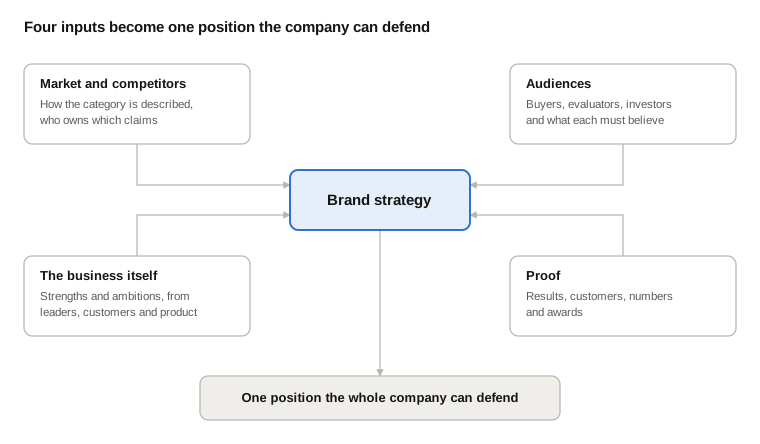
A strategy that holds up in the market must be built from several distinct inputs. Each one provides a different piece of the puzzle:
- Market and competitors: how the category is described today, who owns which claims, and which positions are still open.
- Audiences: every group that decides the company's future, from the economic buyer and the technical evaluator to investors and candidates, and what each needs to believe.
- The business itself: the real strengths, proof and ambitions, gathered from leadership, customers and the people closest to the product.
- Proof: results, customers, numbers and awards that make a claim credible rather than aspirational.
Effective brand strategy is not about any single input. It is a synthesis problem that requires stitching these together into one position the whole company can defend.
Why Complexity Breaks Traditional Branding
The core problem for complex companies is not a weak logo. It is that the way buyers research has changed while most B2B messaging has not. Buyers now arrive at the first call with a shortlist already formed, built from the website, peer recommendations, analyst lists and, increasingly, answers from AI assistants such as ChatGPT and Claude.
For a technical company, this removes the moment it relied on: the demo where an engineer could finally explain the product. If the brand cannot make the case on its own, the company is filtered out before that moment arrives. This doesn't just slow growth; it decides which deals the company ever gets to see.
Consider a cybersecurity vendor whose homepage reads "AI-powered, cloud-native, zero-trust platform." So do the homepages of its five closest competitors. A CFO on the buying committee cannot tell them apart, so the committee defaults to the best-known name. The vendor's technology was never evaluated. That sequence, where undifferentiated language quietly removes a company from consideration, is why treating brand as decoration is no longer viable.
The pressure is not limited to websites. AI assistants summarise a category in a few sentences and name a handful of companies. They favour brands that state clearly what they do, for whom, and with what proof, repeated consistently across the web. A company that describes itself differently on every page gives them nothing to quote.
Positioning: Restoring Clarity Without Dumbing Down the Product
If features cannot differentiate a complex company, positioning must rely on something buyers can actually compare: the business problem they own. This is the principle behind problem-led positioning, which restores clarity without stripping out the substance technical evaluators need.
The technique works through a set of questions, including:
- Which problem does the buyer lose sleep over, in their words rather than ours?
- What does the buyer do today instead, and what does that cost them?
- Which proof shows we solve it better, for whom, and by how much?
- Which single idea could every team repeat without a script?
The answers become a positioning statement and a short message hierarchy: one idea at the top, then distinct proof for each audience beneath it. For example, Mobileye needed to win drivers who wanted reassurance and fleet managers who wanted economics. One umbrella idea, "Modern Driving Needs Modern Technology," carried both, with safety proof for drivers and insurance-savings proof for fleets.
It is important, however, to be clear about what positioning cannot do. It cannot invent strengths a company does not have, and it fails when leadership will not commit to one idea. The value lies in giving every team the same answer to the question buyers ask first: why you?
Building the Brand System: From Positioning to Every Touchpoint
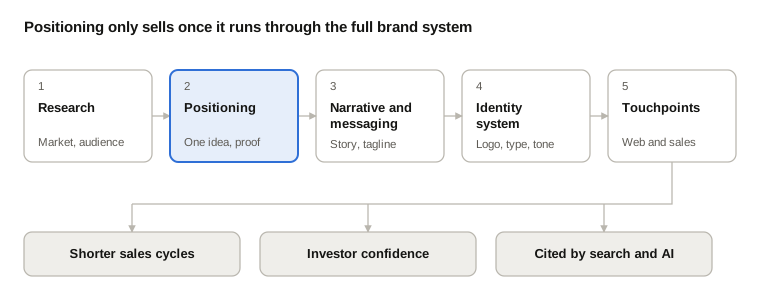
A positioning statement, even a sharp one, is not yet a brand. It becomes a brand when it is translated into the narrative, identity and materials that buyers actually meet. This translation layer is what separates a strategy document that sits in a folder from a brand that wins deals. The process involves two critical steps: building the narrative and building the identity system.
The quality of a company's brand is determined by the quality of this system, not just the quality of its logo. For a company like Helix Robotics, the new positioning must first become a story the CEO tells investors, then a homepage headline, then a sales deck, before it can show up consistently in every room the company is not in.
Narrative and Messaging
The brand narrative is the long-form story: the problem in the world, why it matters now, and why this company is built to solve it. Messaging breaks that story into reusable parts: a tagline, a one-line description, an elevator pitch and proof points per audience.
This is the step that makes a brand quotable. Search engines and AI assistants both reward the same thing: a clear, consistent description of what a company does, repeated across its website, profiles and press. Without it, a brand can describe what it is building but cannot be cited.
Identity System and Brand Experience
Once the story is clear, the identity gives it a face: logo, colour, typography, imagery and tone of voice. In B2B, the identity has a specific job beyond looking good. It must signal the category position, so a challenger looks confident next to incumbents and an enterprise vendor looks trustworthy to a risk-averse buyer.
The identity must then work across every format: website, product UI, sales decks, trade-show booths, social video and investor materials. For TYPE5, the first venture capital firm focused on space technology, that meant an identity built to scale from a screen to a two-metre statue. Consistency across these touchpoints is where a brand becomes commercially useful.
Read more: TYPE5 case study
Connecting Brand to Commercial Decisions
Brand is not an end in itself. Its value is measured by the commercial decisions it makes easier. For B2B technology companies, those decisions fall into two broad categories: winning customers and winning capital. A brand that changes neither adds cost without adding value.
Shorter Sales Cycles and Fewer Lost Deals
A clear brand does part of the sales team's work before the first call. Buying committees arrive already understanding the category position, the main proof and why the company is different. Sales conversations move from "what do you do?" to "how would this work for us?"
Consider Helix Robotics again. After repositioning around the problem its buyers own, cutting picking errors during peak season, its sales team stops leading with the 40-feature list. Every rep, deck and web page now tells the same story, and buyers can repeat it to the colleagues who were not in the room. That repeatability is what moves a deal through a seven-person committee.
Brand Campaigns That Build Demand
B2B brand campaigns work when they speak to the people who actually use the product, not just to the trade. Rivulis, the world's second-largest drip-irrigation maker, sold a product that is largely black tube, in a category where every competitor marketed specifications. A 2:26 brand film built on solidarity with farmers, with no call to action, earned 4.96M views and 47% view-through on LinkedIn, and won Best Brand Campaign at The Drum Awards B2B 2020.
The lesson is not that every company needs a film. It is that B2B audiences respond to brands that understand their world, and that brand building can be measured like any other investment.
Read more: Rivulis case study
Branding at Inflection Points: Funding Rounds, Mergers and IPOs
For many technology companies, the timing of brand work is dictated by a non-negotiable event: a raise, a merger, a new market or a public listing. At these moments, new audiences judge the company quickly, often before anyone from the company is in the room.
Where these events apply, the brand must be ready before the event, not rebuilt after it. Investors read the website before the pitch. Analysts compare the company's story with its peers'. Employees of a newly merged firm need to know which story they now tell.
The stakes extend beyond external perception. If the story changes between the investor deck, the website and the sales materials, the company has a credibility problem even if each document is good on its own. This creates a gap that sophisticated audiences notice at once. A single positioning, applied everywhere, removes that risk.
Mergers carry their own version of the problem. When Prospera was formed from two family wealth management groups, the new brand had to carry both legacies and earn client trust from day one. Clients of both families needed to recognise the new firm as their own.
How Sagi&Co. Turns Positioning into a Brand That Sells
The challenges outlined above, crowded categories, multiple buying audiences and high-stakes inflection points, often force companies into a fragmented project. A strategy consultancy writes the positioning, a design studio builds the identity, and a web agency builds the site, each with its own interpretation.
Sagi&Co., an award-winning branding agency in Toronto, takes a converged approach to this problem. It combines brand strategy, identity and digital experience in a single engagement, led by the same senior team from first interview to launch.
- Brand strategy defines the position, the narrative and the message hierarchy for every audience.
- Brand identity turns that position into a logo, visual system and tone of voice built for the category.
- Digital and campaigns carry it into the website, sales materials, events and brand campaigns.
Because one team owns the whole chain, the positioning written for investors is the same one that appears on the homepage and in the sales deck. Founder Yaron Sagi, who has worked with Apple, Meta, Nike, Disney and Mobileye, writes the positioning and stays in the room when it becomes a logo.
The most important shift for technology companies is to recognise that B2B branding is no longer a design problem that a new logo can solve. It is a strategic problem that requires positioning, narrative, identity and proof to be addressed together.
Buyers have structurally changed how they choose. Clear positioning restores the company's ability to be understood without a demo, but that clarity only becomes revenue when it flows through a full brand system into every touchpoint. The whole chain must be ready before the moments that matter most.
Companies that continue to treat brand as decoration will keep losing deals they never knew they were in. Treating it as an integrated part of the go-to-market gives every team, from sales to the CEO, the same answer to "why you?" That shift depends on applying brand strategy across the whole business rather than to isolated assets.
Frequently Asked Questions
What is the difference between B2B brand strategy and B2B marketing?
Brand strategy defines who the company is, where it wins and why it is different. Marketing uses that definition to generate demand through campaigns, content and channels. Without a brand strategy, marketing teams each invent their own story, and spend is spread across messages that do not add up.
How long does a B2B rebrand take?
It depends on scope. A focused positioning sprint can take a few weeks, while a full rebrand with new positioning, identity, website and sales materials usually runs over several months. Companies facing a fixed date, such as a raise or an IPO, should plan backward from that date.
When should a technology company rebrand?
The clearest signals are a company that has outgrown its story, such as a new product, market or business model; a merger; an upcoming funding round or IPO; or a sales team that struggles to explain why buyers should choose it. If the website describes the company it was two years ago, it is time.
How do you measure the ROI of a B2B brand?
Measure the commercial decisions the brand is meant to change: win rates, sales-cycle length, average deal size, inbound demand and branded search. Campaign-level metrics such as views and view-through rates show whether the story is landing. Set a baseline before launch so the change can be seen.
Does branding matter for AI search and answer engines?
Yes. AI assistants summarise categories and recommend a handful of companies, and they favour brands described clearly and consistently across the web. A sharp one-line description, case studies with real outcomes, and consistent listings on review sites all make a brand easier to recommend.
Should a technical company simplify its message?
It should clarify, not simplify. Lead with the business problem in the buyer's language, then provide technical depth for the evaluators who need it. A clear top-line message and detailed proof underneath can live in the same brand.
Facing a similar challenge?
Book a 30-minute call