
AI Search and B2B Branding: How Answer Engines Decide Which Companies to Recommend
Being recommended by AI is now a branding problem, not only a search problem.
Key Takeaways
- B2B buyers increasingly ask AI assistants such as ChatGPT, Claude, Perplexity and Google's AI answers for shortlists, so the first round of vendor selection can happen without a single website visit.
- Answer engines recommend companies they can describe clearly and verify from several sources, which makes positioning and consistency the foundations of AI visibility.
- Different engines cite different sources, yet they tend to converge on the same brands, because they reward the same underlying signals.
- Third-party proof, such as case studies, reviews, press and directory listings, carries weight that a company's own claims cannot.
- AI visibility is not a one-off project: it is a repeatable process of auditing what engines say, sharpening the definition and publishing proof.
For a growth-stage company like the fictional Fleetwise, a fleet telematics platform for mid-sized logistics firms, the problem surfaces through a prospect. A head of operations mentions that she asked an AI assistant for "the best telematics platforms for regional trucking fleets." It named four companies. Fleetwise was not one of them, even though it serves more regional fleets than two of the four. When the marketing team tries the same question, the assistant describes Fleetwise as "a GPS tracking app," a product the company stopped selling three years ago.
The core tension is simple: buyers now ask machines to summarise a market, and machines can only repeat what the market says about you. If that record is thin, outdated or inconsistent, the company is described wrongly or not at all.
This guide explains how answer engines decide which companies to recommend and what B2B technology brands can do about it. We will cover what AI search visibility actually involves, why traditional SEO alone no longer covers it, and which brand signals engines rely on. We will then walk through a practical process, connect it to pipeline and revenue, and look at what changes during a rebrand or a launch.
What AI Search Visibility Actually Involves
AI search visibility is the likelihood that an AI assistant or answer engine will name, describe and recommend a company accurately when a buyer asks about its category. It is related to search engine optimisation, but it is not the same thing. A search engine returns a list of links. An answer engine writes a short answer and names a handful of companies inside it.
For a B2B technology company, the difference matters. In a list of ten links, a company on page one still gets a chance to make its case. In a written answer, there may be room for three to five names. A company that is not named never gets the click, the visit or the demo request.
Answer engines build those answers from what they can find and trust: the company's own pages, but also articles, reviews, directories, forums and partner sites. That makes AI visibility a question of brand clarity and reputation as much as of technical optimisation.
Core Signals Answer Engines Rely On
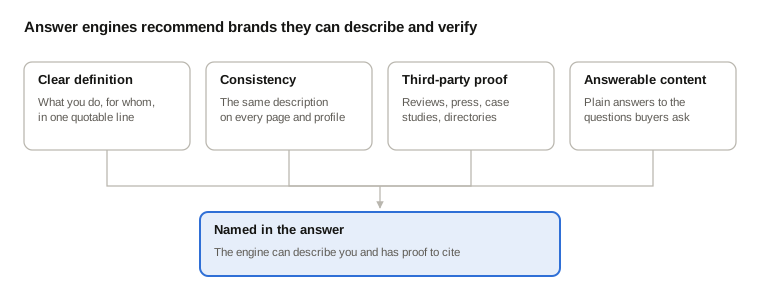
Engines differ in which sources they prefer, but published analyses of AI citations point to the same broad signals. Each one does a different job:
- A clear definition: a plain statement of what the company does, for whom and in which category, written so it can be quoted in one sentence.
- Consistency: the same description repeated across the website, social profiles, directories, press and partner pages, so the engine sees agreement rather than conflict.
- Third-party proof: case studies with real outcomes, customer reviews, awards and independent coverage that confirm the claim.
- Answerable content: pages that answer the questions buyers actually ask, in plain language, with clear headings and direct answers.
No single signal is enough. A brilliant definition that appears only on the homepage is easy to overlook, and proof without a clear definition leaves the engine unsure what the company is.
Why Traditional SEO Alone No Longer Covers It
Most B2B marketing teams built their search programmes around keywords, rankings and backlinks. That work still matters, because many answer engines draw on search results when they compose an answer. But it no longer covers the whole journey from question to shortlist.
The shift is in what gets judged. A ranking algorithm judges pages. An answer engine judges companies: it has to decide what each company is, whether it fits the question and whether it is credible enough to name. Those are brand questions. A company can rank well for a keyword and still be summarised poorly if its pages describe it in five different ways.
Consider a fictional cybersecurity vendor that ranks well for "endpoint protection for hospitals." Its blog posts attract traffic, but its homepage calls it an "AI security platform," its LinkedIn page says "managed detection," and its directory listings still use a product name it retired. When a hospital IT director asks an assistant for recommended vendors, the engine finds conflicting descriptions and little independent proof. It names competitors with a simpler, consistent story instead. The vendor's search traffic looks healthy, while its share of AI recommendations is close to zero.
Published comparisons of AI engines also show that each one leans on different sources. One may favour encyclopaedic and editorial sites, another review platforms and forums, another the company's own pages. Optimising one channel in isolation is fragile. A clear, consistent brand that shows up across many sources is what holds up across all of them.
Brand Clarity: Making a Company Easy to Describe and Easy to Trust
If answer engines reward companies they can describe and verify, the brand's first job is to become easy to describe. This is the same discipline as positioning, applied to a new kind of reader that never gets a demo and never asks a follow-up question in a meeting.
A useful way to test clarity is to answer the questions an engine implicitly has to answer:
- In one sentence, what does the company do, and for whom?
- Which category does it belong to, in the words buyers use when they search?
- What proof would an independent observer find for its main claim?
- Does every public description of the company say the same thing?
The answers should become a short definition that every team and every channel repeats. Mobileye offers a useful parallel from before AI search existed. Ahead of its public listing, one umbrella idea, "Modern Driving Needs Modern Technology," carried the brand to drivers and fleet managers alike, with distinct proof for each audience. One idea repeated everywhere, with proof underneath it, is exactly the pattern answer engines reward today.
Read more: Mobileye case study
It is important, however, to be clear about the limits. No company can control what an AI assistant says, and engines change how they choose sources as they are updated. Brand clarity raises the odds of being described accurately and named; it does not guarantee a place in every answer. Any promise of guaranteed AI rankings should be treated with caution.
Applying It: A Repeatable AI Visibility Process
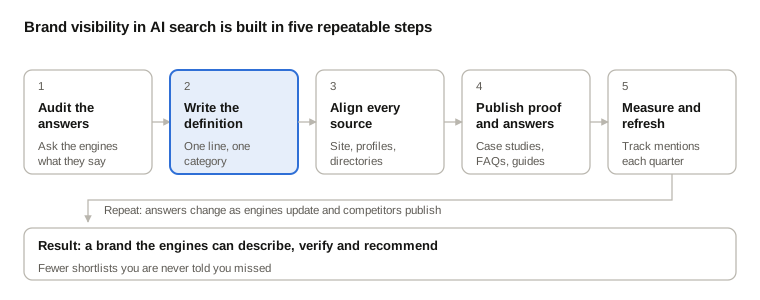
Brand clarity becomes AI visibility only when it reaches the places engines read. That means treating AI search as a recurring process rather than a campaign. The process involves two critical parts: getting the company's own story right, and building the external record that confirms it.
For a company like Fleetwise, the process starts with listening. The team asks the main assistants the questions its buyers ask and records how each one describes the company and its competitors. That audit shows the gap between the brand the company believes it has and the brand the market can actually see.
Owned Sources: The Website and Profiles
The company's own channels must tell one story. The homepage headline, the about page, the product pages, the LinkedIn description and the boilerplate in press releases should all use the same definition and the same category language.
Structure helps too. Clear headings, short direct answers to common questions, frequently asked questions written the way buyers phrase them, and structured data that labels the organisation, its products and its articles all make content easier for engines to read and quote. For more on building the underlying message, see B2B brand strategy for complex technology companies.
Earned Sources: Proof Beyond the Website
Engines give extra weight to what others say. That makes case studies with specific outcomes, client reviews on recognised platforms, accurate directory listings, awards, partner pages and press coverage part of the brand system, not an afterthought.
Rivulis shows how earned proof compounds. Its brand film for farmers earned 4.96M views and 47% view-through on LinkedIn and won Best Brand Campaign at The Drum Awards B2B 2020. An award, a case study and widespread coverage create the kind of independent record that any researcher, human or machine, can find and cite.
Read more: Rivulis case study
Connecting AI Visibility to Commercial Decisions
AI visibility is not a vanity metric. Its value lies in the commercial decisions it influences before the company knows a buyer exists. For B2B technology companies, those decisions fall into two areas: getting onto shortlists and shaping how buyers arrive.
Getting onto the Shortlist
When an assistant names four vendors, the shortlist is partly formed before any sales team is involved. A company that is named gets researched; a company that is not named is rarely added later. For Fleetwise, being missing from that answer meant losing deals it never saw, which no win-rate report would show.
Tracking this requires new habits. Teams can record, on a regular schedule, how often the company is named for its key questions, how it is described and which competitors appear alongside it. The trend matters more than any single answer, because responses vary from one session to the next.
Shaping How Buyers Arrive
Being named is only half the outcome. The description matters as well. A buyer who arrives believing the company is "a GPS tracking app" starts the sales conversation in the wrong place, and the first meeting is spent correcting the record.
When the engines repeat the company's own definition, buyers arrive with the right category, the right problem and the right expectations. Sales conversations can move faster to fit and value, which is exactly what a clear brand is meant to do.
AI Visibility During Rebrands and Launches
The risk is highest when a company changes. A rebrand, a new name, a merger or a product launch creates a period in which the web holds two versions of the company. Answer engines may keep repeating the old description long after the new brand is live, because older pages, directories and articles still say so.
That means a rebrand plan should include the external record, not only the new website. Old directory listings, partner pages, social profiles and press boilerplate need updating, and new proof should be published under the new name as quickly as possible. For the wider question of timing, see when to rebrand a technology company.
Group structures add another layer. When several companies sit under one parent, engines need to understand how they relate. A clear architecture, with consistent naming and an explicit link between the group and each company, helps them describe the group as one business instead of several unrelated ones.
How Sagi&Co. Builds Brands That Answer Engines Can Recommend
The challenges outlined above, unclear definitions, inconsistent descriptions and thin external proof, often fall between teams. Positioning sits with strategy, the website with marketing and digital, and reviews or directories with no one in particular.
Sagi&Co., a branding design firm in Toronto, treats these as one brand system. Strategy, identity and digital experience are led by the same senior team, so the definition written in the strategy is the one that appears on the website and across the company's public record.
- Brand strategy defines the company in one clear, quotable sentence, with the category language buyers use and the proof that supports it.
- Brand identity and messaging carry that definition consistently through every page, profile and piece of content.
- Websites and campaigns build clear, well-structured pages and the case studies and proof that independent sources can cite.
Founder Yaron Sagi has worked with Apple, Meta, Nike, Disney and Mobileye, and has helped lead companies through IPOs, exits and investment rounds. That experience shapes how each brand is built to be understood quickly by any audience, including the machines that now introduce companies to buyers.
The most important shift for B2B technology companies is to recognise that AI search visibility is a branding outcome. Engines do not recommend the companies that shout loudest; they recommend the companies they can describe clearly and verify from several sources.
That makes positioning, consistency and proof the working parts of AI visibility. A sharp definition gives engines something to quote, consistency gives them confidence, and third-party proof gives them a reason to recommend. The process has to be repeated, because the engines and the competition keep moving.
Companies that leave their public record to chance will keep losing places on shortlists they never knew existed. Companies that manage it as part of their brand will be introduced to buyers the way they want to be introduced. That is the practical case for building brand strategy with AI search in mind.
Frequently Asked Questions
How do AI assistants decide which companies to recommend?
They draw on what they can find and trust about a category, including company websites, articles, reviews, directories and forums. Companies that are described clearly and consistently, with independent proof behind their claims, are easier for engines to understand and more likely to be named. Each engine weights sources differently, so broad consistency matters.
Is AI search optimisation the same as SEO?
They overlap but are not the same. SEO focuses on ranking pages for keywords, while AI visibility depends on whether an engine can describe and trust the company as a whole. Good SEO helps, because many engines use search results, but clear positioning and third-party proof matter just as much.
Can a company control what ChatGPT says about it?
No company can control it directly. What a company can do is make its own description clear and consistent, correct outdated information on directories and profiles, and publish proof that independent sources can confirm. Over time, that raises the chance that engines describe the company accurately.
How can I check how AI assistants describe my company?
Ask the main assistants the questions your buyers ask, such as "best platforms for" your category, and record which companies they name and how they describe yours. Repeat the same questions on a regular schedule, because answers vary between sessions and change as engines update.
Does a rebrand affect AI search visibility?
Yes. During a rebrand, the web holds both the old and the new description, and engines may keep repeating the old one. Update directories, profiles, partner pages and press boilerplate as part of the launch, and publish new proof under the new name quickly.
What content helps a B2B company get recommended by AI?
Content that answers buyer questions directly: a clear definition of what the company does, product pages in plain language, frequently asked questions, and case studies with specific outcomes. Independent coverage, reviews and awards add the external confirmation that engines look for.
Facing a similar challenge?
Book a 30-minute call