
When to Rebrand a Technology Company: Signals to Act Before a Funding Round or IPO
The best time to rebrand is before the moment that makes it urgent.
Key Takeaways
- A technology company should rebrand when the business has changed faster than the story, not when the logo starts to feel dated.
- The clearest signals are commercial: sales cannot explain the company in one sentence, new audiences misread it, and every team tells a different story.
- Funding rounds, mergers and IPOs raise the stakes, because new audiences judge the company quickly and compare it with its peers.
- A rebrand timed for a big event must be finished before the event, which means planning backward from the date, not forward from the kickoff.
- Most strong rebrands are evolutions: they keep the equity buyers already recognise and change what no longer fits.
For a scale-up like the fictional Orbis Analytics, the question arrives in a board meeting. The company started as a data tool for retailers. Five years later it sells an AI platform to banks, insurers and logistics firms, and it plans to raise a Series C in nine months. A new board member asks a simple question: "Why does your website still talk about retail dashboards?" Nobody in the room has a good answer.
The core tension is simple: technology companies change faster than their brands, and the gap stays invisible until a high-stakes audience notices it. By then, the time to fix it calmly has often passed.
This guide explains how to tell when a rebrand is needed and how to time it. We will cover what a rebrand actually involves, why waiting for a crisis breaks the process, and which signals matter most. We will then walk through how to plan a rebrand backward from a fixed date, how it connects to commercial decisions, and what changes when the event is an IPO or a merger.
What a Rebrand Actually Involves
A rebrand is a deliberate change to how a company defines, describes and presents itself, so that its brand matches the business it has become. It is not the same as a logo refresh. A refresh updates the look; a rebrand changes the position, the story and the system that carries it.
For a growth-stage technology company, the difference matters. A new logo on an old story leaves the real problem in place. Sales still struggles to explain why buyers should choose the company, and investors still see a business that sounds smaller than it is.
A rebrand can be large or small. It can be a full change of name and identity, or a sharper position expressed through an evolved identity. The scope should follow the gap between the brand and the business, not a wish for something new.
Core Signals That a Company Has Outgrown Its Brand
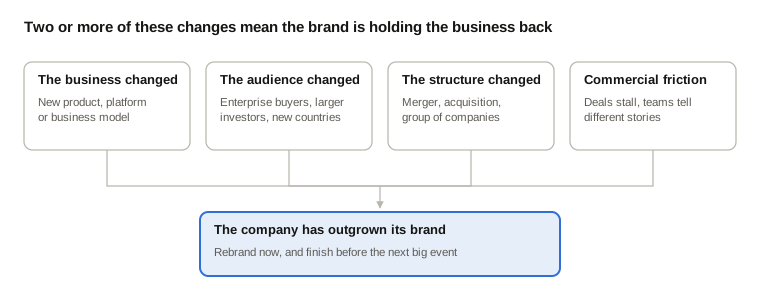
Most rebrands are triggered by one of four kinds of change. Each one creates a different kind of gap:
- The business has changed: a new product, a platform shift, a new business model, or a move from one market to several.
- The audience has changed: the company now sells to enterprise buyers, raises from larger investors, or hires in new countries.
- The structure has changed: a merger, an acquisition, a spin-off, or a group of companies that now needs to work as one.
- The commercial friction is visible: deals stall on "what do you do?", messaging differs by team, and the brand looks smaller than the competition.
One signal alone may only need a messaging update. When two or more appear together, the brand is usually holding the business back.
Why Waiting for a Crisis Breaks the Rebrand
The most common mistake is not rebranding too often. It is rebranding too late. Many companies start only when an event forces the issue: a term sheet, a merger announcement or a listing date. At that point the work is squeezed into weeks, and the decisions that need the most care get the least time.
A rushed rebrand tends to fail in predictable ways. Research is skipped, so the new position is built on assumptions. Leadership has no time to align, so the story changes again a month after launch. The identity is designed before the strategy is settled, and the website launches with old copy under a new logo.
Consider a fictional cybersecurity company that schedules its rebrand to start after its Series B closes. The investors it pitched read a website that described a product it no longer sold. Two of them passed, citing an unclear market focus. The company had the right strategy in its board deck; it simply was not visible anywhere investors looked. The rebrand it then completed was good, but it arrived after the audience that mattered most had already formed a view.
Reading the Signals: Rebrand Before the Moment, Not After
If timing is the risk, the answer is to read the signals early and act on them while the company still controls the calendar. The principle is simple: rebrand when the gap appears, and finish before the event that will expose it.
A short diagnostic helps leadership decide whether the gap is real. Useful questions include:
- Can every executive describe the company in the same sentence, and would a buyer recognise it?
- Does the website describe the company we are today, or the one we were two years ago?
- Do our largest new customers and investors understand our position without a meeting?
- Do our brand and materials look like they belong next to the competitors we now face?
When Mobileye was preparing to list on NASDAQ, the challenge was exactly this kind of gap. One brand had to win the trust of drivers who wanted reassurance and fleet managers who wanted economics, ahead of a public listing. A single brand strategy and the idea "Modern Driving Needs Modern Technology" carried both audiences, supported by global campaigns, a new corporate website and the IPO book. Mobileye listed at an $18B valuation.
Read more: Mobileye case study
It is important, however, to be honest about what a rebrand cannot do. It cannot fix a business model that does not work, and it cannot replace proof the company does not yet have. A rebrand amplifies what is true about the business. If the substance is not there, a new brand will make the gap more visible, not less.
Planning a Rebrand Backward from the Date
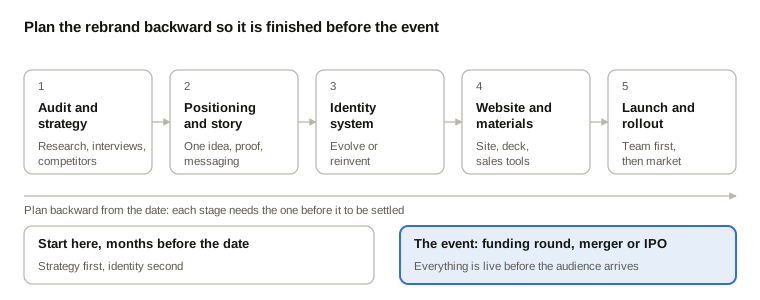
Once the decision is made, the most useful planning tool is the calendar. A rebrand tied to a funding round, a merger or an IPO has a fixed deadline, so the plan should start from that date and work backward. Each stage needs enough time for the next one to build on it.
For a company like Orbis Analytics, that means the new story must be settled long before the pitch deck is designed. The positioning has to be agreed before the identity starts, and the website and sales materials need time to be rebuilt, tested and launched before investors begin their research.
Strategy First, Identity Second
The order of work matters more than the speed. Research and positioning come first: what the company now stands for, who it serves and why it wins. The narrative and messaging follow, then the identity that gives that story a face.
Reversing the order is the most expensive shortcut. An identity designed before the strategy is settled usually has to be redesigned when the strategy changes. It also invites debates about taste, because there is no agreed position to judge the design against.
Evolve or Reinvent
Not every rebrand needs a new name or a new logo. The right choice depends on how much equity the current brand holds with customers, partners and the market. Where recognition is strong, an evolution keeps what people already know and modernises the rest.
UVeye, an AI vehicle-inspection company, took this path. The new UVEYE mark was historically inspired by the original logo, keeping its colours, line-drawn letters and eye, while evolving them into a purer and more distinctive style. A new parent brand, UVIQ, and one family of marks for its products let the company present a platform, not a single scanner.
Read more: UVeye case study
Where the old brand holds little equity, or actively misleads buyers about what the company does, a reinvention is the better choice. Eccomelt, for example, needed a ground-up rebrand to reposition an aluminium company as a green-tech leader for the automotive industry.
Connecting a Rebrand to Commercial Decisions
A rebrand is an investment, so it should be judged by the commercial decisions it makes easier. For technology companies, those decisions fall into two groups: raising capital and winning customers. A rebrand that changes neither has missed its purpose.
Raising Capital on a Clear Story
Investors research a company before the first meeting. They read the website, search for coverage and compare the story with the pitch deck. When all three tell the same story, the meeting can focus on the business. When they conflict, time is spent explaining the gaps.
A rebrand completed before a raise lets the company show its new position everywhere at once. The deck, the website and the founder's one-line description all match, and the company looks like the business investors are being asked to value.
Winning Larger Customers
Moving upmarket is one of the most common reasons a technology company outgrows its brand. Enterprise buyers judge risk, and they read polish, clarity and consistency as signs of a vendor that will still be there in five years.
A rebrand gives the sales team a story built for that buyer. Every rep, deck and web page explains the same problem, the same solution and the same proof, so a buying committee can repeat the story to colleagues who were not in the room. For more on how positioning drives that clarity, see B2B brand strategy for complex technology companies.
Rebranding Around Mergers and IPOs
Two events deserve special care, because the audiences change and the timing is fixed. A merger creates a new organisation that has to earn trust from the customers and employees of both companies at once. An IPO introduces analysts, public investors and the press, who will compare the company with every listed peer.
In a merger, the first decision is architecture: one master brand, a group brand that endorses its companies, or separate brands. When AXIS Group was created, seven companies across corporate travel, logistics and luxury aviation looked unrelated. A new umbrella group brand let them align as one unified entity, with each company keeping its name under the group's endorsement.
Read more: AXIS Group case study
Before an IPO, timing becomes a legal question as well as a creative one. Securities rules limit promotional communication around an offering, so major brand launches are best completed well before the listing process begins. Companies should agree their timing with their legal and banking advisers early.
How Sagi&Co. Rebrands Technology Companies Before Their Biggest Moments
The challenges outlined above, a business that has outgrown its story, fixed deadlines and new audiences, often push companies into a rushed, fragmented rebrand. Strategy, identity and website are handled by different teams, each with its own interpretation, under time pressure.
Sagi&Co., a branding design firm in Toronto, approaches the rebrand as one connected engagement. Strategy, identity and digital experience are led by the same senior team from the first interview to launch.
- Brand strategy defines what the company now stands for, for every audience, including investors.
- Rebranding and identity decide what to keep, what to retire and how the new identity should look in the category.
- Website and campaigns carry the new story into the places investors and buyers check first.
Founder Yaron Sagi has worked with Apple, Meta, Nike, Disney and Mobileye, and has helped lead companies through IPOs, exits and investment rounds. That experience shapes how each rebrand is planned around the moment that matters most.
The most important shift for technology companies is to treat a rebrand as a timing decision, not a design decision. The question is not whether the logo looks dated. It is whether the brand still describes the business, and whether it will be ready before a new audience arrives.
The signals usually appear well before the deadline: a sales team that cannot explain the company, investors who misread it, and teams that tell different stories. Reading those signals early leaves room to do the work in the right order, with strategy first and identity second.
Companies that wait for a term sheet or a listing date will keep rebranding under pressure. Companies that plan backward from their biggest moments arrive at them with one clear story. That is the practical case for treating rebranding as part of the company's growth plan.
Frequently Asked Questions
How do I know if my technology company needs a rebrand?
Look for gaps between the brand and the business. If the company has a new product, market or business model, if sales cannot explain it in one sentence, or if the website describes the company you were two years ago, the brand has fallen behind. Two or more of these signals together usually justify a rebrand.
How long before a funding round should a tech company rebrand?
Start early enough for the new story, website and materials to be live before investors begin their research. Plan backward from the date of the raise, leaving time for research, positioning, identity and the website. A rushed rebrand during the raise itself usually causes more confusion than it solves.
What is the difference between a rebrand and a refresh?
A refresh updates the look of a brand, such as the logo, colours or typography, while the position stays the same. A rebrand changes what the company stands for, how it describes itself and how it is presented. A company that has changed its business usually needs a rebrand, not only a refresh.
Should a company change its name when it rebrands?
Only when the name holds the company back, for example when it describes a product or market the company has left, or causes legal or pronunciation problems. Many strong rebrands keep the name and evolve the identity, because the name already carries recognition with customers and investors.
How should a rebrand be handled before an IPO?
Complete the strategy and the main brand launch well before the offering process, and agree the timing with legal advisers, because securities rules limit promotional communication around an offering. The goal is for analysts and investors to find one consistent story across the website, the prospectus and the press.
How do you rebrand after a merger?
Start with brand architecture: decide whether the new company will use one master brand, a group brand that endorses each company, or separate brands. Then build a story that both customer bases and both teams can recognise as their own, and launch it to employees before customers.
Facing a similar challenge?
Book a 30-minute call